Residents across Devon were once again reminded of the legacy of WWII this week after two unexploded bombs (UXBs) were uncovered at separate incidents in Plymouth and Exmouth.
Both discoveries prompted large-scale evacuations, road closures and extensive bomb disposal operations as specialists assessed and made the wartime devices safe.
Plymouth: German SC50 Unexploded Bomb Found at Millbay Construction Site
On Wednesday 14th January 2026, during UXO Survey investigation works which involved magnetometer testing for unexploded ordnance (UXO), a subsurface anomaly was detected. A controlled target investigation was subsequently carried out, which exposed an item of UXO – buried approximately 4.3 metres below ground level.
The item was identified by specialists as a German WWII SC50 air-delivered unexploded bomb, a type of general-purpose bomb used extensively by the Luftwaffe.
Emergency services, including Devon and Cornwall Police, swiftly put in place a 100-metre cordon around the site – which was later expanded to a 400-metre safety zone affecting nearby homes, businesses, hotels and the Millbay Academy school.
Local authorities and the military brought in specialist X-ray equipment to help determine the safest way to make the device safe. After detailed planning, the bomb was removed from the site using the least disruptive method available – and was transported for controlled disposal at sea in the early hours of Friday 16th January.
A spokesperson from Devon and Cornwall Police thanked residents for their cooperation and confirmed that many households have since been able to return home following the successful removal of the device.
Plymouth Sutton and Devonport MP Luke Pollard said: “The major operation to safely remove an unexploded device in Millbay concluded in the early hours of this morning. I am pleased to hear that the security cordon has now been officially lifted, and residents are free to return to their homes and businesses.”
Exmouth: German SC250 WWII Unexploded Bomb Dredged from Exmouth Marina
On the same day, a much larger WWII unexploded bomb was discovered in Exmouth Marina during routine dredging operations.
The device, reported as being a German SC250 air-delivered high-explosive bomb, led to the local authorities imposing a 400-metre safety cordon around the marina and adjacent residential areas.
The evacuation zone affected up to around 2,000 homes and an estimated 5,000 residents, who were asked to leave their properties overnight while assessment and mitigation planning continued.
Local authorities later confirmed the cordon was extended and that emergency services – including Royal Navy EOD experts – were preparing to move the bomb to a secure offshore location for controlled disposal at sea in high tide.
Police and council statements emphasised the scale of the operation, warning of “significant impacts” for the town and urging the public to stay away from the affected areas while mitigation planning is ongoing.
Devon and Cornwall Police Assistant Chief Constable Nikki Leaper said the bomb had been safely removed and was now at sea.
She said: "The multi-agency partnership working over 72 hours, I’m so proud of all our partners. We are trained to do this. All cordons are now lifted and people can return to their homes. It is out at sea at the moment about to be detonated.”
Ongoing Legacy of WWII Unexploded Ordnance (UXO) and Public Safety
Both incidents highlight how UXO from WWII continues to surface more than 80 years later. The discovery of such devices demonstrate why UXO Risk Assessments and early mitigation are critical during groundworks and redevelopment – particularly in city centres which were targeted during WWI & WWII.
Information about the German SC50 & SC250 Bombs
During WWII, German air raids most commonly utilised high-explosive bombs in the 50kg and 250kg classes, alongside heavier variants such as the 500kg and more rarely – the 1,000kg and above.
The SC50 and SC250 (from Sprengbombe Cylindrisch, or “cylindrical high-explosive bomb”) were among the Luftwaffe’s most widely used general-purpose weapons. Thin-cased and designed to maximise blast effect rather than fragmentation, these bombs were intended for the demolition of buildings, infrastructure and urban targets.
The smaller SC50 was frequently deployed in large numbers, while the SC250 became a standard weapon for medium bombers and fighter-bombers. Although these bombs were aimed at military, industrial or transport targets – the limitations of wartime navigation and poor bombing accuracy meant that many fell well outside their intended targets.
As a result, unexploded SC50 and SC250 bombs are still regularly discovered today in residential areas, former industrial areas and construction sites across the UK.
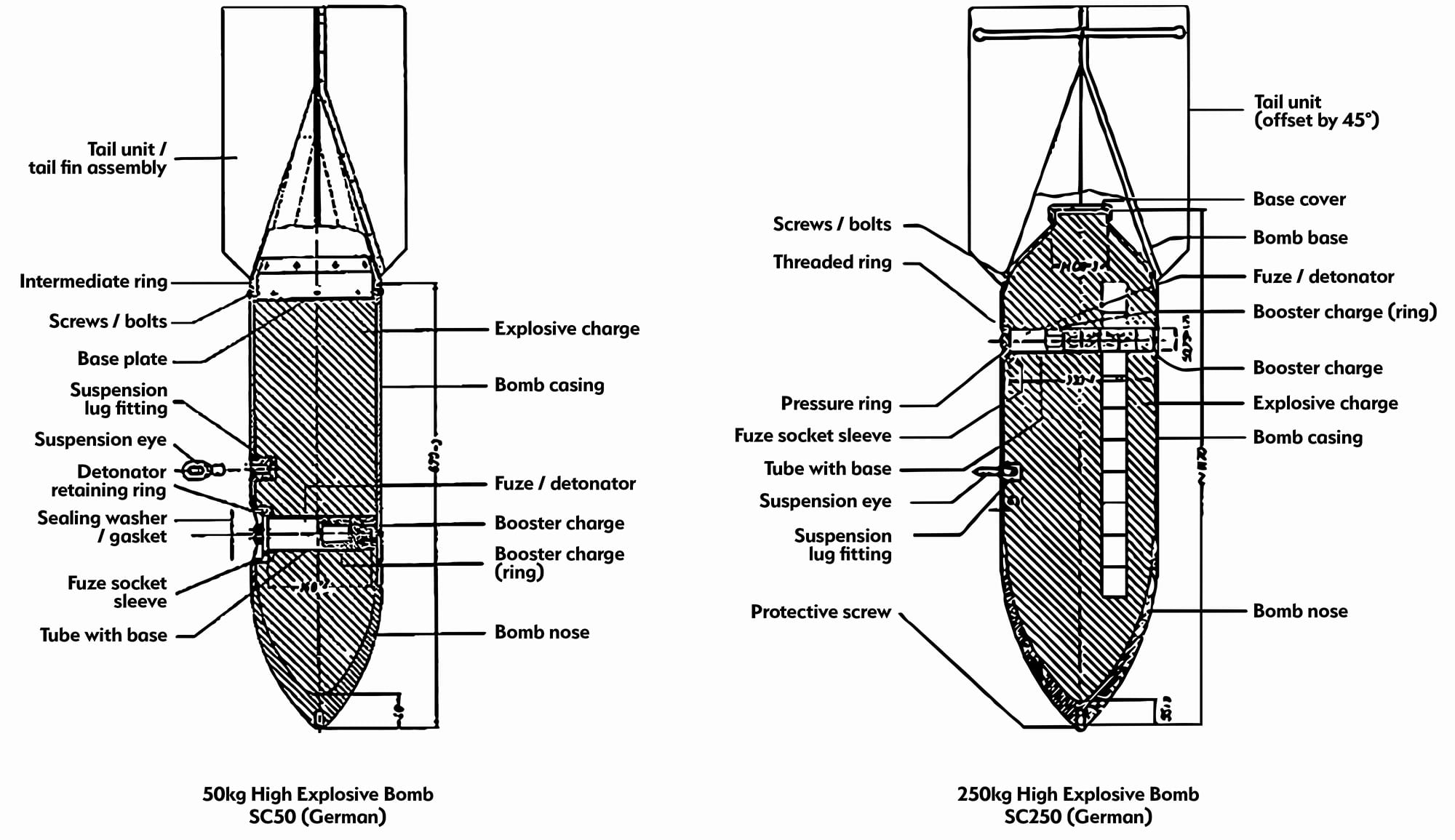
Image showing schematic drawings of SC50 and SC250 German Bombs which were commonly used during WWII.
How can 1st Line Defence help?
At 1st Line Defence, we strongly recommend that UXO risk is considered early in any project involving groundworks or seabed disturbance. Our comprehensive UXO services include desktop risk assessments, detailed technical surveys and specialist disposal operations to help protect people, infrastructure and project timelines.
For expert advice on mitigating UXO risk across your project, contact our team on: +44 (0) 1992 245020 or info@1stlinedefence.co.uk.