Home » Resources » UXO City Guides »
UXO City Guide
Home Office Bombing Statistics for Belfast
Record of German Ordnance dropped on the County Borough of Belfast
High Explosive Bombs (All types)
525
Parachute Mines
48
Oil Bombs
0
Phosphorus Bombs
0
Fire Pots
0
Pilotless Aircraft (V-1)
0
Long-range Rocket Bombs (V-2)
0
Weapons Total
573
Area Acreage
1,586
Number of items per 1,000 acres
37.5
Why was Belfast targeted and bombed in WWII?
During WWII, Belfast was a key British port connected to the Atlantic, home to significant industries which posed as potential bombing targets for the Luftwaffe. These included shipbuilding works, dockyards, and aircraft factories along the River Lagan, as well as the production of linen, flour and tobacco. Whilst attacks on Belfast were initially unprecedented given its distance from the European mainland, the Luftwaffe still considered its infrastructure to be of great enough importance to raid.
The most notable industries attacked by the Luftwaffe include the Harland & Wolff shipyards and the Short & Harland aircraft factory, both of which were involved in the production of military vehicles. These included Royal Navy cruisers and aircraft carriers, and Royal Air Force seaplanes and bombers, which directly contributed to Britain’s military power during WWII.
Luftwaffe target photography of Belfast. Image credit: Public Records Office of Northern Ireland
Home Office Bombing Statistics for Belfast
Details obtained from the official Home Office bombing statistics, highlights the volume and type of bombs that fell on County Borough of Belfast throughout WWII. A total of 573 recorded bombs fell on Belfast, equating to 37.5 items of ordnance per 1,000 acres.
The bombing records that survive for Belfast are varied, with several bomb maps and written records being available acquired from the Public Record Office of Northern Ireland, online efforts to document the Belfast Blitz and information found at the Titanic Quarter.
Records of bombing across the city are available, although are not always considered to be comprehensive. The Harland & Wolff shipyards and Short & Harland aeroplane factory both have their own extensive records and bomb maps which provide a detailed insight.
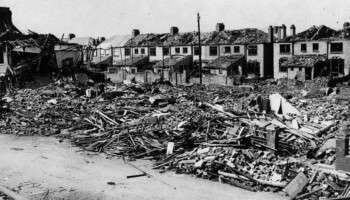
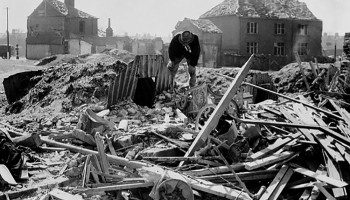
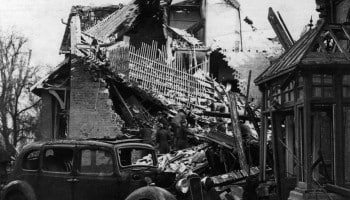
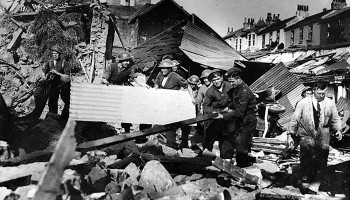
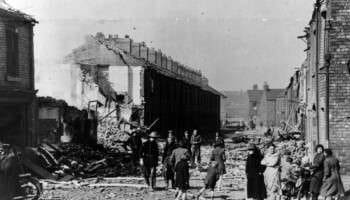
Damaged residences at Westbourne Street in the aftermath of the Belfast Blitz. Image credit: WartimeNI
Major bombing raids in Belfast
Belfast suffered a total of four notable air raids during WWII. Historical accounts suggest that Belfast was relatively unprepared and undefended during the earlier stages of WWII, and that Luftwaffe raids were unexpected. This was likely due to an illusion of safety provided by the city’s considerable distance from occupied Europe, where German bomber bases were situated. Belfast avoided any air raids throughout 1940; the year in which the bulk of bombing on Britain occurred, initially suggesting that Belfast may not be targeted. At the start of 1941, only four public air raid shelters existed in the city, made of sandbags around the city hall. The city also lacked barrage balloons or any fighter squadrons for home defence of airspace.
On the night of the 7-8th April 1941, Belfast’s sense of security came to an abrupt end when an attack came from the Luftwaffe focused upon Belfast’s docks. It involved six Heinkel HE 111 bombers. Strikes were concentrated on the Harland & Wolff shipyards, although also struck some neighbouring residential areas. The raid caused limited damage and few casualties, but highlighted the city’s lack of defensive measures.
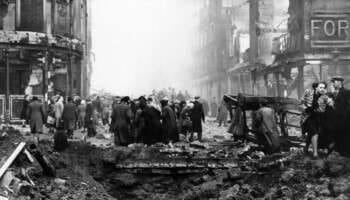
Following the first raid, which is speculated to have been carried out to assess the city’s defences, a major raid was being planned. On Easter Tuesday; on the 15th of April 1941, approximately 150 enemy bombers attacked the city, forming the largest and most-devastating raid on the city. Targets included Belfast’s water works and power station, and several of Harland & Wolff’s dry docks containing vessels. Numerous public buildings and residential areas were also attacked and damaged including Belfast City Hall, York Road railway station and many streets in the city centre – including the High Street.
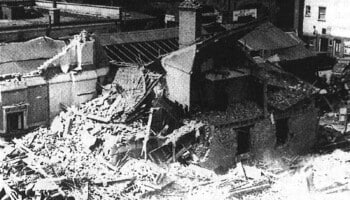
Parachute of a German mine suspended from telegraph lines in the aftermath of a bombing raid. Image credit: WartimeNI
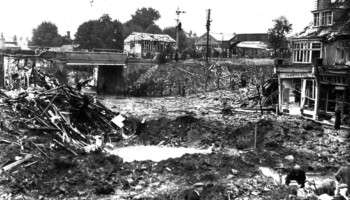
The raid resulted in a total of 750 bombs and 29,000 incendiaries being dropped, including 203 tonnes of high explosives. The city did little to defend itself, with anti-aircraft defences holding fire in the mistaken belief that RAF fighters might be damaged. It resulted in approximately 55,000 houses being damaged and approximately 600-700 civilian deaths; the greatest loss of life in a night raid outside of London during the Blitz.
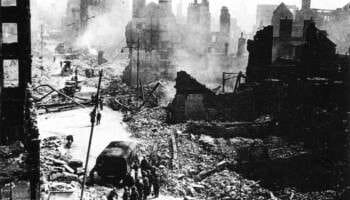
Photograph showing the extent of destruction at the Harland & Wolff shipyard following the Belfast Blitz. Image credit: WartimeNI
Another large raid on Belfast occurred on the 4-5th May 1941. Luftwaffe bombers again concentrated bombing upon Harland & Wolff shipyards at Queen’s Island; today known as the Titanic Quarter. Some residential areas of east Belfast were also hit, as well as parts of the north and centre. Local firefighting capabilities were stretched due to a low tide and damage to water works from the previous raid.
Approximately 800 canisters containing 96,000 incendiary bombs were dropped, giving this raid its name as the Fire Raid. Casualties were fewer than the Easter Tuesday raid due to the pre-emptive sounding of air raid sirens and greater caution from the Luftwaffe.
Aerial photograph of Belfast city centre and dockyards from October 1952 following a period of partial post-war rebuilding. Image credit: Public Records Office of Northern Ireland
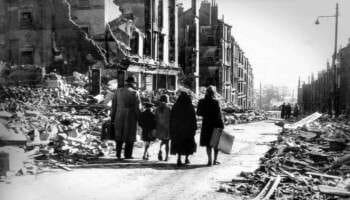
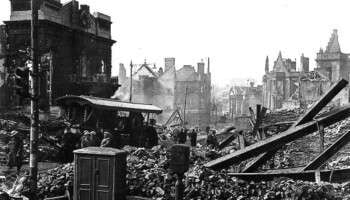
A final raid on Belfast occurred on the 5-6th May 1941. However, this raid’s effect was limited and casualties few, as many of the city’s residents had evacuated. The physical effects of the Belfast Blitz were significant, with over 1,300 houses being demolished, another 5,000 badly damaged and nearly 30,000 left slightly damaged. It is believed that as many as 50% of the city’s houses were affected and around 1,000 people were killed.
A post-1941 map of Belfast showing the approximate areas affected by the four bombing raids. Image credit: Public Records Office of Northern Ireland
Modern production of a consolidated bomb map of Belfast. Image credit: BlitzMaps.co.uk
1940s’ bomb damage map for the Harland & Wolff shipyards in Belfast. Image credit: Titanic Quarter
Can UXO still pose a risk to construction projects in Belfast?
Yes – UXO can still present a potential risk to construction and development projects in Belfast.
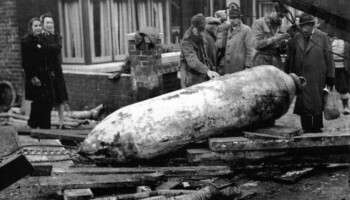
The primary threat comes from German air-delivered bombs dropped during WWII that failed to detonate as intended. It is estimated that around 10% of munitions deployed across the UK did not function correctly. Although significant wartime and post-war bomb disposal operations were carried out, not all unexploded bombs (UXBs) were located or removed.
Ongoing discoveries of UXO during intrusive groundworks across the UK continue to demonstrate that buried wartime ordnance remains a potential risk – including in areas such as Belfast.
I am about to start a project in Belfast, what should I do?
Before any intrusive groundworks begin, developers, principal contractors, and ground investigation teams should assess potential UXO risk through either:
This forms the first stage of an effective UXO risk mitigation strategy and should be undertaken as early as possible in the project lifecycle, in line with CIRIA C681 guidance.
Why does an early UXO Risk Assessment matter?
Where a credible risk is identified, appropriate mitigation measures should be implemented to reduce risk to As Low As Reasonably Practicable (ALARP).
Equally, unnecessary mitigation can create avoidable project costs, delays and operational disruption.
A professional UXO Risk Assessment will make sure:
- Site-specific threats are properly identified.
- Appropriate mitigation strategies are recommended.
- Unnecessary mitigation measures are avoided.
- Projects remain compliant, safe and commercially efficient.
Early-stage UXO Risk Assessments help developers make informed decisions, protect personnel, maintain compliance and avoid unnecessary expenditure.
If you are planning development or intrusive groundworks in Belfast, obtaining a professional and unbiased UXO Risk Assessment should be your first step.
Recent UXO discoveries in Belfast
Since the war, many items of UXO have been discovered across multiple cities within the UK, with Belfast no exception. See the news articles below about UXO incidents and discoveries from national and local press in Belfast.
1st Line Defence keep up-to-date with relevant and noteworthy UXO-related news stories reported across the UK, and you can browse through these articles using the buttons below.
Press articles 2026 Press articles 2025 Press articles 2024
Get UXO risk mitigation services from a partner you can trust
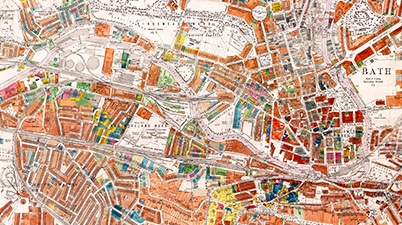
UXO Risk Assessments
Site-specific UXO Risk Assessments using specialist historical research to identify potential threats and determine whether further mitigation is required.
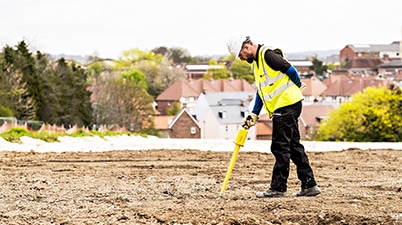
UXO Surveys
Detect and investigate potential buried UXO with specialist Non-intrusive and Intrusive Surveys tailored to your site and proposed groundworks.
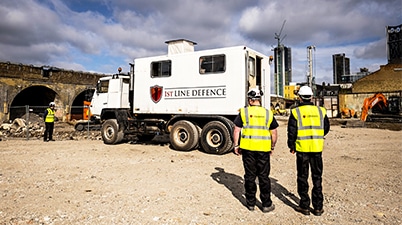
UXO Support
On-site UXO support to manage potential ordnance risks during groundworks, protecting personnel and helping your project proceed safely and efficiently.
Free Awareness CPD Seminars
Helping construction professionals understand UXO risk, its potential impact on projects and how it can be effectively managed.
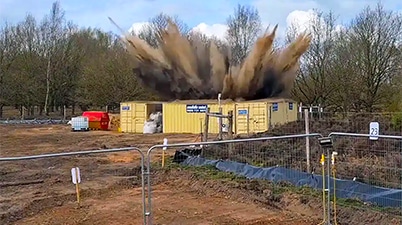
UXO Disposal
Safely manage UXO discoveries with specialist EOD support, from investigation and identification through to clearance and disposal.
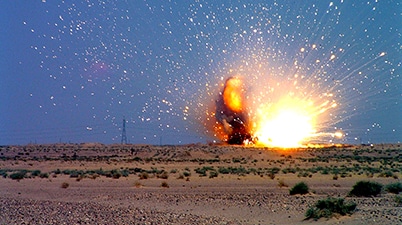
International UXO Services
Specialist EOD teams supporting international UXO survey, clearance and disposal projects, with personnel available for rapid deployment worldwide.
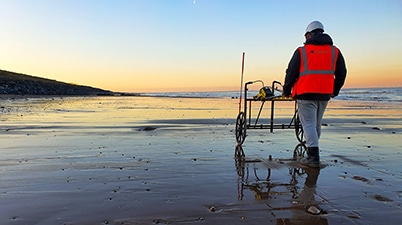
Marine UXO Services
Manage UXO risk on marine and offshore projects with specialist survey, investigation, clearance and disposal services tailored to your project.
UXO City Guides
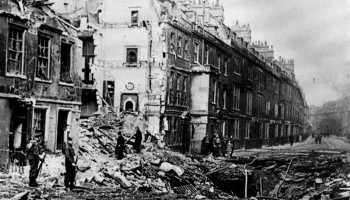

Got a project in Belfast? Need advice but not sure where to start?
If you need general advice about UXO risk mitigation in Belfast, contact us and we will be happy to help.










Contact Us
* indicates required fields