Home » Resources » UXO City Guides »
UXO City Guide
Home Office Bombing Statistics for Nottingham
Record of German Ordnance dropped on the County Borough of Nottingham
High Explosive Bombs (All types)
422
Parachute Mines
0
Oil Bombs
3
Phosphorus Bombs
0
Fire Pots
0
Pilotless Aircraft (V-1)
0
Long-range Rocket Bombs (V-2)
0
Weapons Total
425
Area Acreage
16,172
Number of items per 1,000 acres
26.3
Why was Nottingham targeted and bombed in WWII?
Nottingham was not among the most heavily bombed cities in the UK during WWII. It was for the most part spared during Nazi Germany’s nine month ‘Blitz’ of London and other British cities. Only one raid of significance occurred during this time – an isolated incident on the 15th January 1941 which killed 15 people.
However, Nottingham did famously produce various military materiel such as boots, textiles, weapons and other supplies, making it important to the British war effort, and therefore not entirely out of the Luftwaffe’s sights.
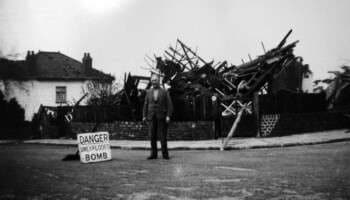
It saw its largest raid on the night of 8-9th May 1941. Incendiary and high-explosive bombs were dropped across the city, resulting in substantial damage to infrastructure and housing.
Nottingham’s ‘Blitz’ of 9th May 1941
Starting shortly after midnight, and finishing at around 4:30am, Nottingham was subjected to 11 separate raids1. Targets included the Basford Gas Works, Boots, the National Ordnance Factory on Castle Meadow Road, Chilwell Ordnance Depot, the factories of Raleigh and Players, Wilford Power Station and the Lady Bay Bridge2.
An example of one of many pre-war German military target/reconnaissance maps is presented below.
Luftwaffe target photography of Nottingham. This map identifies the Midland Machine Works and Gas Works in the city. Image credit: Imperial War Museum
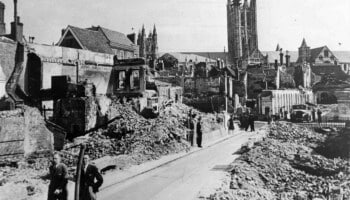
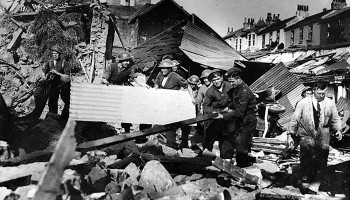
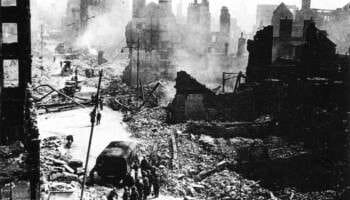
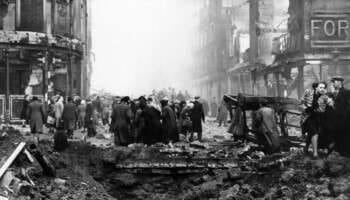
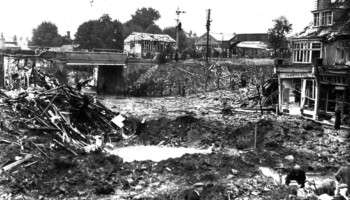
Over 400 high explosive bombs were dropped, in additional to countless incendiaries. At least 200 people were killed, with over 270 injured. A total of 200 houses were destroyed, and more than 4,500 damaged3.
One eyewitness recalled “The sky was red – as though the world had come to an end … The dust was just like a sandstorm. Buildings were ablaze, water pipes were gushing and there were mounds of brick and rubble everywhere.”
Below is an extract of a bomb map showing the locations of bomb strikes in Nottingham, held at Nottingham Central Library. HE bombs are shown as large black dots and depict the presence of bombing around the Lower Parliament Street area.
Map showing the locations of bombing in Nottingham during WWII. Published in the Nottingham Evening Post, 17th May 1945.
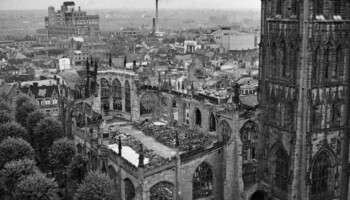
The Lace Market reportedly became an inferno. Boots factories in Poplar, Island and Station Streets were seriously damaged. Trent Bridge Cricket Ground and both Forest and County football stadiums were hit. St John’s Church, Leenside was destroyed; the tower of St Mary’s Nottingham caught fire, nearby St Christopher’s was reduced to a shell. The old Moot Hall on Friar Lane, the Masonic Hall on Goldsmith Street, sections of University College and Shakespeare Street’s Register Office were damaged4.
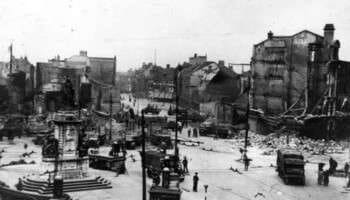
The raid cut swathes through the districts of Stapleford, Beeston, Mapperley Park, Woodborough Road, St Ann’s and West Bridgford. However, it was the areas of Sneinton and the Meadows which sustained the worst damage, with sections of London Road, Colwick Road and Carlton Road totally destroyed.
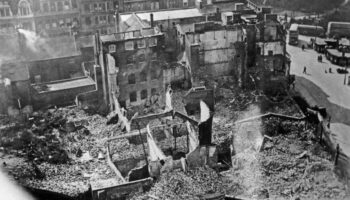
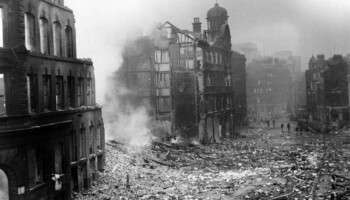
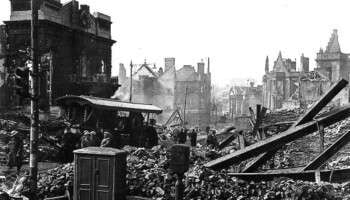
An image showing the devastation caused in the heart of the Lace Market, Nottingham. This photograph was taken from the roof of a warehouse in Stoney Street. (Image credit: Nottingham At War, A Pictorial Account 1939-45)
‘It could have been worse’ – the success of Nottingham’s Bombing Decoy Sites
As bad as the raid was, it is thought the damage could have been considerably worse without the ‘Starfish’ decoy site at nearby Cropwell Butler, 8km south-east of Nottingham (see image below). Starfish sites were large-scale night-time decoys created during the Blitz to simulate burning British cities and towns. The aim was to divert Luftwaffe night bombers from their intended targets so they would drop their ordnance over the surrounding countryside.
The first wave of bombers would often drop incendiary bombs to ‘light up’ the target area for subsequent bombers. The decoy sites would mimic a burning town, and subsequent waves of aircraft would hopefully mistake that for the primary target, bombing it instead.
It is reported that many bombs destined for the centre of Nottingham fell on the Cropwell Butler decoy and in fields the Vale of Belvoir.
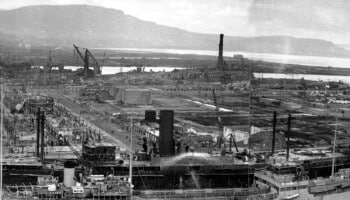
Image showing an RAF aerial photography of the Cropwell Butler Bombing Decoy Site – 19th April 1944. The layout of the various oil tanks, fire simulations and lighting effects can be clearly seen around a year after the site was decommissioned. (Image credit: Historic England)
Nottingham was not subject to any more raids of such a scale, although further raids occurred over the city sporadically, mainly as a result of poor Luftwaffe navigation.
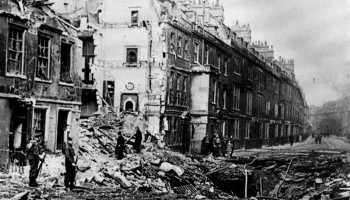
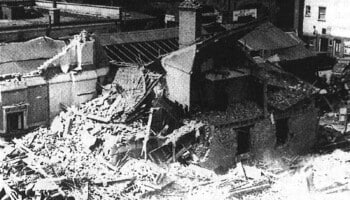
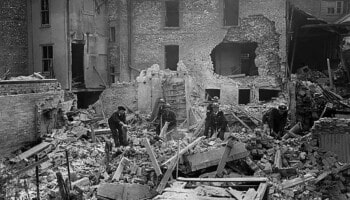
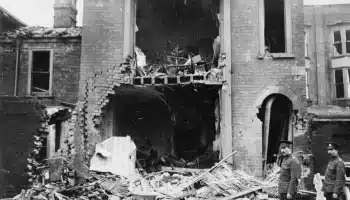
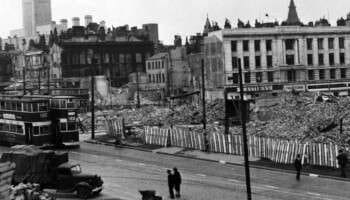
A further example of the destruction on Shakespeare Street, Nottingham, following the raid on the 8-9th May 1941. (Image credit: University of Nottingham Collection UMP 2/1/42/4)
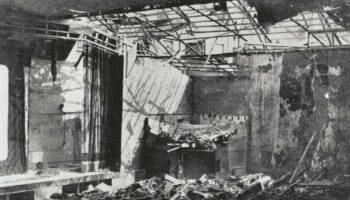
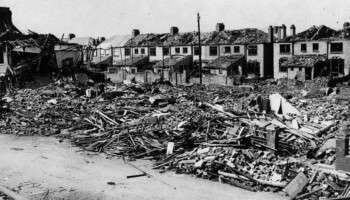
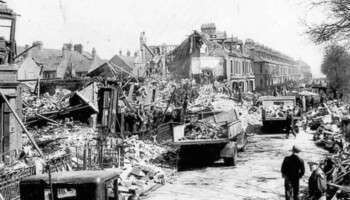
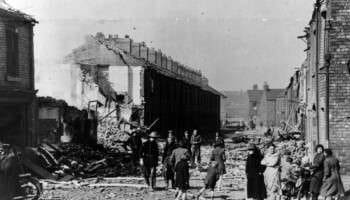
Image showing damage in a residential area of Nottingham following the bombing raid of the 8-9th May 1941. (Image credit: Nottingham Post)
Home Office Bombing Statistics for Nottingham
Details obtained from the official Home Office bombing statistics, indicates the quantity and type of bombs that fell on the County Borough of Nottingham during WWII (excluding incendiary bombs). A total of 425 recorded bombs were recorded, equating to 26.3 items of ordnance per 1,000 acres.
Can UXO still pose a risk to construction projects in Nottingham?
Yes – UXO can still present a potential risk to construction and development projects in Nottingham.
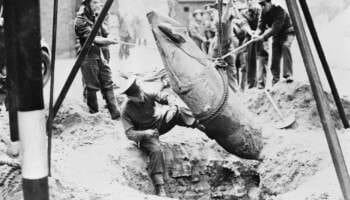
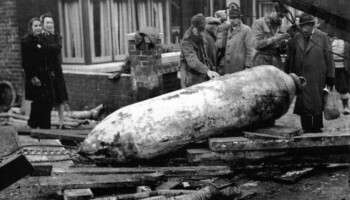
The primary threat comes from German air-delivered bombs dropped during WWII that failed to detonate as intended. It is estimated that around 10% of munitions deployed across the UK did not function correctly. Although significant wartime and post-war bomb disposal operations were carried out, not all unexploded bombs (UXBs) were located or removed.
Ongoing discoveries of UXO during intrusive groundworks across the UK continue to demonstrate that buried wartime ordnance remains a potential risk – including in areas such as Nottingham.
I am about to start a project in Nottingham, what should I do?
Before any intrusive groundworks begin, developers, principal contractors, and ground investigation teams should assess potential UXO risk through either:
This forms the first stage of an effective UXO risk mitigation strategy and should be undertaken as early as possible in the project lifecycle, in line with CIRIA C681 guidance.
Why does an early UXO Risk Assessment matter?
Where a credible risk is identified, appropriate mitigation measures should be implemented to reduce risk to As Low As Reasonably Practicable (ALARP).
Equally, unnecessary mitigation can create avoidable project costs, delays and operational disruption.
A professional UXO Risk Assessment will make sure:
- Site-specific threats are properly identified.
- Appropriate mitigation strategies are recommended.
- Unnecessary mitigation measures are avoided.
- Projects remain compliant, safe and commercially efficient.
Early-stage UXO Risk Assessments help developers make informed decisions, protect personnel, maintain compliance and avoid unnecessary expenditure.
If you are planning development or intrusive groundworks in Nottingham, obtaining a professional and unbiased UXO Risk Assessment should be your first step.
Recent UXO discoveries in Nottingham
Since the war, many items of UXO have been discovered across multiple cities within the UK, with Nottingham no exception. See the news articles below about UXO incidents and discoveries from national and local press in Nottingham.
1st Line Defence keep up-to-date with relevant and noteworthy UXO-related news stories reported across the UK, and you can browse through these articles using the buttons below.
Get UXO risk mitigation services from a partner you can trust
UXO Risk Assessments
Site-specific UXO Risk Assessments using specialist historical research to identify potential threats and determine whether further mitigation is required.
UXO Surveys
Detect and investigate potential buried UXO with specialist Non-intrusive and Intrusive Surveys tailored to your site and proposed groundworks.

UXO Support
On-site UXO support to manage potential ordnance risks during groundworks, protecting personnel and helping your project proceed safely and efficiently.
Free Awareness CPD Seminars
Helping construction professionals understand UXO risk, its potential impact on projects and how it can be effectively managed.
UXO Disposal
Safely manage UXO discoveries with specialist EOD support, from investigation and identification through to clearance and disposal.

International UXO Services
Specialist EOD teams supporting international UXO survey, clearance and disposal projects, with personnel available for rapid deployment worldwide.

Marine UXO Services
Manage UXO risk on marine and offshore projects with specialist survey, investigation, clearance and disposal services tailored to your project.
UXO City Guides




Got a project in Nottingham? Need advice but not sure where to start?
If you need general advice about UXO risk mitigation in Nottingham, get in touch.












Contact Us
* indicates required fields