Home » Resources » UXO City Guides »
UXO City Guide
Home Office Bombing Statistics for Chelmsford
Record of German Ordnance dropped on the Metropolitan Borough of Chelmsford
High Explosive Bombs (All types)
198
Parachute Mines
10
Oil Bombs
4
Phosphorus Bombs
47
Fire Pots
54
Pilotless Aircraft (V-1)
4
Long-range Rocket Bombs (V-2)
3
Weapons Total
320
Area Acreage
4,772
Number of items per 1,000 acres
67.1
Why was Chelmsford targeted and bombed in WWII?
During WWII, Chelmsford was one of the most important manufacturing hubs in Essex, and was home to a number of significant factories for the Allied war effort. It was often a reserve objective for German bombers that had missed their London targets, as well as an easy target for lone ’tip and run’ raiders.
A number of factories were directly identified by the Luftwaffe, and appeared on reconnaissance maps and images. One such facility was the Marconi Wireless Telegraph Co. Ltd, presented in the following photo dating from October 1941.
Chelmsford was also situated on the General Headquarters Hardened Stop Line. This line of pillboxes, gun emplacements and strongpoints was designed to hold back an anticipated German Invasion, and provide a rallying point for defending troops. Whilst the line was never used to repel an invasion, many of the pillboxes and emplacements can still be seen to this day.
Luftwaffe target photography of Chelmsford. Image credit: Imperial War Museum
Home Office Bombing Statistics for Chelmsford
Details obtained from the official Home Office bombing statistics, indicates the quantity and type of bombs that fell on the Metropolitan Borough of Chelmsford during WWII (excluding incendiary bombs). A total of 320 recorded bombs were recorded, equating to 67.1 items of ordnance per 1,000 acres.
Primary Bombing Targets
Chelmsford housed two main bombing targets for German bombers:
- Hoffmann’s Factory: This factory produced ball bearings essential for wartime production, including joints bearings and machinery used in thousands of applications – including military vehicles, tanks and aircraft.
- Marconi’s Radio Factory: Known for its pioneering telegraphic communications research and production. Marconi was the centre for military radio production, making man-portable, vehicle and aircraft radios – as well as components for all manner of communications equipment. It also managed several shadow factories across the country producing Marconi equipment under licence.
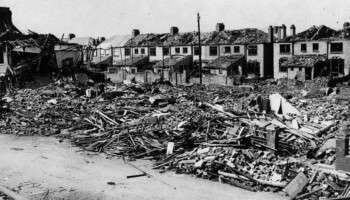
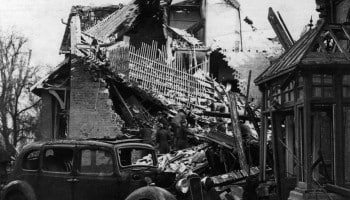
Image showing houses in Park Avenue severely damaged by a one tonne bomb that fell in the Essex Home School' recreation ground in Chelmsford. Image credit: Internal Resource
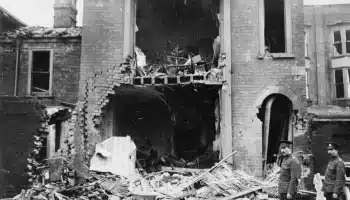
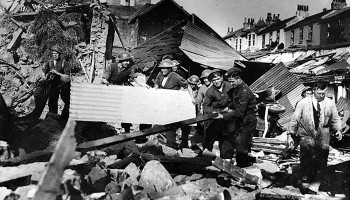
View of the junction between Victoria Road and Duke Street where a bomb caused extensive damage to Hawkes Brothers' shop in Chelmsford. Image credit: Internal Resource
Major WWII bombing incidents in Chelmsford
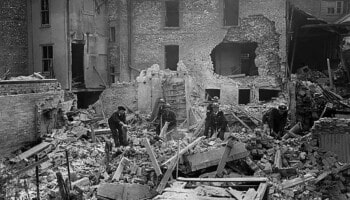
One of the worst conventional raids in Chelmsford took place in May 1941, when the Marconi works was attacked. Three 500kg and two 250kg bombs, including several delayed action bombs, were dropped in an accurate raid on the factory. The bombing raid destroyed much of the machine and paint shops, and a row of houses nearby. A number of men trapped in the burning paint shop were killed but the worst incident in Chelmsford was sadly yet to come.
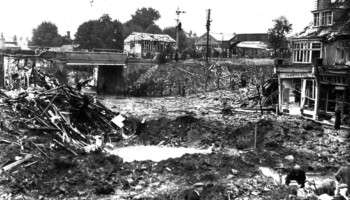
On the 19th December 1944, a German V-2 rocket struck close to the Hoffmann works. The rocket exploded near Hoffmann’s C Factory’s Cage & Assembly Department, devastating the area. The incident caused the town’s greatest loss of life from a single wartime event, with 39 fatalities. Several dwellings in Henry Road were completely destroyed, and many nearby streets suffered damage.
To record bombing over the city, Chelmsford produced a bomb map (see below), which documented the location, type and date of each incident. These are supplemented by bomb damage records, which provide more detailed accounts of the incidents, the resultant damage and any measures taken to remediate the situation.
Extract of map showing ‘Location of Enemy Bombs’, Chelmsford 1939-45. Image credit: Essex Record Office
Both the Hoffmann and Marconi works also maintained their own bomb damage maps and files which provide more a more detailed insight into incidents. The city is also covered by Ministry of Home Security bomb census mapping and tracings, which highlights the precise location, size and details of the bombs which fell during each recorded incident (see example below).
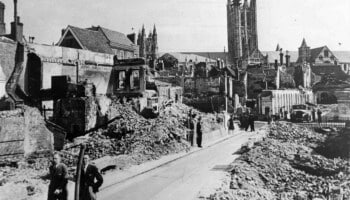
Thankfully, a number of landmarks in the city survived the bombing, including Chelmsford’s magnificent Gothic cathedral; dating back 800 years, as well as the 18th-century Shire Hall and the Stone Bridge (dating to 1784) which also endured the war.
Extract of a bomb map/tracing for a raid on Duke Street, Chelmsford, May 1943. Image credit: The National Archives
Can UXO still pose a risk to construction projects in Chelmsford?
Yes – UXO can still present a potential risk to construction and development projects in Chelmsford.
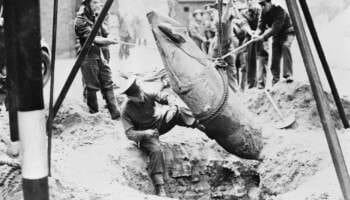
The primary threat comes from German air-delivered bombs dropped during WWII that failed to detonate as intended. It is estimated that around 10% of munitions deployed across the UK did not function correctly. Although significant wartime and post-war bomb disposal operations were carried out, not all unexploded bombs (UXBs) were located or removed.
Ongoing discoveries of UXO during intrusive groundworks across the UK continue to demonstrate that buried wartime ordnance remains a potential risk – including in areas such as Chelmsford.
I am about to start a project in Chelmsford, what should I do?
Before any intrusive groundworks begin, developers, principal contractors, and ground investigation teams should assess potential UXO risk through either:
This forms the first stage of an effective UXO risk mitigation strategy and should be undertaken as early as possible in the project lifecycle, in line with CIRIA C681 guidance.
Why does an early UXO Risk Assessment matter?
Where a credible risk is identified, appropriate mitigation measures should be implemented to reduce risk to As Low As Reasonably Practicable (ALARP).
Equally, unnecessary mitigation can create avoidable project costs, delays and operational disruption.
A professional UXO Risk Assessment will make sure:
- Site-specific threats are properly identified.
- Appropriate mitigation strategies are recommended.
- Unnecessary mitigation measures are avoided.
- Projects remain compliant, safe and commercially efficient.
Early-stage UXO Risk Assessments help developers make informed decisions, protect personnel, maintain compliance and avoid unnecessary expenditure.
If you are planning development or intrusive groundworks in Chelmsford, obtaining a professional and unbiased UXO Risk Assessment should be your first step.
Recent UXO discoveries in Chelmsford
Since the war, many items of UXO have been discovered across multiple cities within the UK, with Chelmsford no exception. See the news articles below about UXO incidents and discoveries from national and local press in Chelmsford.
1st Line Defence keep up-to-date with relevant and noteworthy UXO-related news stories reported across the UK, and you can browse through these articles using the buttons below.
Get UXO risk mitigation services from a partner you can trust
UXO Risk Assessments
Site-specific UXO Risk Assessments using specialist historical research to identify potential threats and determine whether further mitigation is required.
UXO Surveys
Detect and investigate potential buried UXO with specialist Non-intrusive and Intrusive Surveys tailored to your site and proposed groundworks.

UXO Support
On-site UXO support to manage potential ordnance risks during groundworks, protecting personnel and helping your project proceed safely and efficiently.
Free Awareness CPD Seminars
Helping construction professionals understand UXO risk, its potential impact on projects and how it can be effectively managed.
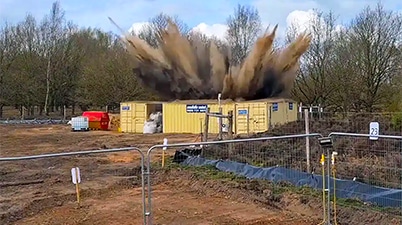
UXO Disposal
Safely manage UXO discoveries with specialist EOD support, from investigation and identification through to clearance and disposal.
International UXO Services
Specialist EOD teams supporting international UXO survey, clearance and disposal projects, with personnel available for rapid deployment worldwide.

Marine UXO Services
Manage UXO risk on marine and offshore projects with specialist survey, investigation, clearance and disposal services tailored to your project.
UXO City Guides
















Got a project in Chelmsford? Need advice but not sure where to start?
If you need general advice about UXO risk mitigation in Chelmsford, contact us and we will be happy to help.












Contact Us
* indicates required fields