Home » Resources » UXO City Guides »
UXO City Guide
Home Office Bombing Statistics for Exeter
Record of German Ordnance dropped on the County Borough of Exeter
High Explosive Bombs (All types)
304
Parachute Mines
6
Oil Bombs
0
Phosphorus Bombs
0
Fire Pots
0
Pilotless Aircraft (V-1)
0
Long-range Rocket Bombs (V-2)
0
Weapons Total
310
Area Acreage
4,721
Number of items per 1,000 acres
65.7
Why was Exeter targeted and bombed in WWII?
As a major city near the south-west coast of England, Exeter was a prominent and fairly convenient target for the Luftwaffe, with bombers flying across the channel not needing to penetrate far into the country to conduct a strategic bombing attack.
19 significant air raids were recorded on Exeter between August 1940 and 1942, resulting in 265 fatalities and almost 800 injuries1. A significant number of smaller ‘tip and run’ raids occurred throughout the war along the south coast. Exeter’s heaviest raids occurred during the so-called ‘Baedeker Blitz’, apparently a retaliation for the RAF bombing of the German city of Lubeck2. These raids did not primarily attack targets for their strategic significance, but their cultural and historic value.
Luftwaffe target photography of Exeter, with railway stations (A), the harbour, gas works (B and C) and barracks (D) highlighted. Image credit: Imperial War Museum
Home Office Bombing Statistics for Exeter
Exeter was not as heavily bombed as Britain’s largest cities, nevertheless the County Borough sustained an overall moderate bombing density according to official Home Office bombing statistics, with an average of 65.7 items of ordnance recorded per 1,000 acres.
While Exeter’s largest raids occurred in 1942, bombing was recorded as early as August 1940. These earlier incidents were relatively infrequent in nature, until the ‘Baedecker’ raid where the city was actively targeted by approximately 40 aircraft. Bombing continued sporadically late into the war, with the final casualty occurring in autumn 1944.
Historic and culturally important buildings with no military significance in Exeter were damaged by bombing, including the Cathedral, in order to demoralise the population. Targets of strategic significance were identified across the city however, as the Luftwaffe reconnaissance photograph above illustrates.
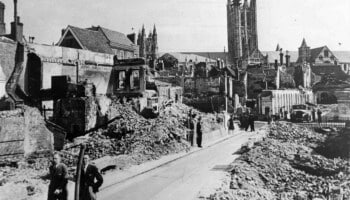
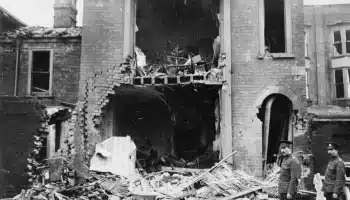
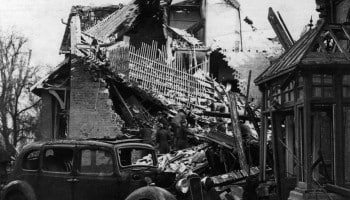
Bombing damage in Paris Street, Exeter – May 1942. Image credit: Devon Live
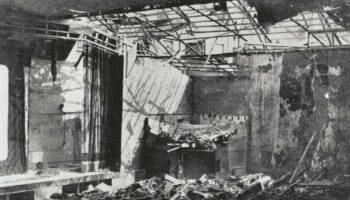
Bomb damage photographed inside Exeter Cathedral, May 1942. Image credit: Google Arts & Culture
Major Air Raid Incidents in Exeter
- 17th September 1940 – six HE bombs dropped in the area around Devon & Exeter Girls’ Training School, resulting in the evacuation of seven streets.
- 28th November 1940 – two parachute mines fall in Heavitree, killing four and injuring 26, and causing damage recorded across an enormous area – more than 20 streets.
- 23rd April 1942 – seven HE bombs and hundreds of incendiary bombs, causing five fatalities and widespread damage and fires.
- 4th May 1942 – the ‘Baedeker’ raid, in which approximately 10,000 incendiary bombs and 160 HE bombs were dropped. The raid caused 156 fatalities, with 563 injured.
- 30th December 1942 – six 500kg HE bombs dropped, killing 19 people.
Clearance areas in central Exeter, 1947. Image credit: Britain from Above
A concentration of bombs in central Exeter, a small portion of those dropped during the Baedeker raid – and excludes the other raids on Exeter.
Areas recorded to have sustained damage as a result of the ‘Baedeker’ raid, May 1942. Image credit: Exeter memories
Detonation of unearthed 1,000kg HE unexploded bomb in Exeter
In early 2021, a very large 1,000kg ‘Hermann’ HE bomb was discovered during excavation works next to a care home near the University of Exeter3. The bomb was deemed unsafe, and was destroyed in situ following evacuation in a 400 metre radius. Despite precautions including surrounding the bomb with more than 400 tonnes of sand, the resulting blast threw debris up to a distance of 250 metres.
The 1,000kg HE unexploded bomb being detonated in situ close to the University of Exeter. Image credit: Youtube
Can UXO still pose a risk to construction projects in Exeter?
Yes – UXO can still present a potential risk to construction and development projects in Exeter.
The primary threat comes from German air-delivered bombs dropped during WWII that failed to detonate as intended. It is estimated that around 10% of munitions deployed across the UK did not function correctly. Although significant wartime and post-war bomb disposal operations were carried out, not all unexploded bombs (UXBs) were located or removed.
Ongoing discoveries of UXO during intrusive groundworks across the UK continue to demonstrate that buried wartime ordnance remains a potential risk – including in areas such as Exeter.
I am about to start a project in Exeter, what should I do?
Before any intrusive groundworks begin, developers, principal contractors, and ground investigation teams should assess potential UXO risk through either:
This forms the first stage of an effective UXO risk mitigation strategy and should be undertaken as early as possible in the project lifecycle, in line with CIRIA C681 guidance.
Why does an early UXO Risk Assessment matter?
Where a credible risk is identified, appropriate mitigation measures should be implemented to reduce risk to As Low As Reasonably Practicable (ALARP).
Equally, unnecessary mitigation can create avoidable project costs, delays and operational disruption.
A professional UXO Risk Assessment will make sure:
- Site-specific threats are properly identified.
- Appropriate mitigation strategies are recommended.
- Unnecessary mitigation measures are avoided.
- Projects remain compliant, safe and commercially efficient.
Early-stage UXO Risk Assessments help developers make informed decisions, protect personnel, maintain compliance and avoid unnecessary expenditure.
If you are planning development or intrusive groundworks in Exeter, obtaining a professional and unbiased UXO Risk Assessment should be your first step.
Recent UXO discoveries in Exeter
Since the war, many items of UXO have been discovered across multiple cities within the UK, with Exeter no exception. See the news articles below about UXO incidents and discoveries from national and local press in Exeter.
1st Line Defence keep up-to-date with relevant and noteworthy UXO-related news stories reported across the UK, and you can browse through these articles using the buttons below.
Get UXO risk mitigation services from a partner you can trust
UXO Risk Assessments
Site-specific UXO Risk Assessments using specialist historical research to identify potential threats and determine whether further mitigation is required.
UXO Surveys
Detect and investigate potential buried UXO with specialist Non-intrusive and Intrusive Surveys tailored to your site and proposed groundworks.

UXO Support
On-site UXO support to manage potential ordnance risks during groundworks, protecting personnel and helping your project proceed safely and efficiently.

Free Awareness CPD Seminars
Helping construction professionals understand UXO risk, its potential impact on projects and how it can be effectively managed.
UXO Disposal
Safely manage UXO discoveries with specialist EOD support, from investigation and identification through to clearance and disposal.

International UXO Services
Specialist EOD teams supporting international UXO survey, clearance and disposal projects, with personnel available for rapid deployment worldwide.

Marine UXO Services
Manage UXO risk on marine and offshore projects with specialist survey, investigation, clearance and disposal services tailored to your project.
UXO City Guides




















Got a project in Exeter? Need advice but not sure where to start?
If you need general advice about UXO risk mitigation in Exeter, contact us and we will be happy to help.












Contact Us
* indicates required fields