Home » Resources » UXO City Guides »
UXO City Guide
Home Office Bombing Statistics for Dover
Record of German Ordnance dropped on the Metropolitan Borough of Dover
High Explosive Bombs (All types)
365
Parachute Mines
1
Oil Bombs
3
Phosphorus Bombs
2
Fire Pots
1
Pilotless Aircraft (V-1)
3
Long-range Rocket Bombs (V-2)
0
Weapons Total
375
Area Acreage
4,447
Number of items per 1,000 acres
108.8
Why was Dover targeted and bombed in WWII?
The town of Dover played an essential role during WWII. Its position meant it was very much on the ‘front line’ of attention from the German military. It was an easy and very reachable target for both the Luftwaffe and for the cross-channel German gun batteries on the north coast of France. At the start of WWII in 1939, the Admiralty took control of the port of Dover transforming the harbour into a naval base, making it a very viable target.
Dover also played a crucial role in Operation Dynamo, being the focal point of the evacuation of Allied soldiers from Dunkirk, France, in the summer of 1940. Dover Castle’s network of secret tunnels became the headquarters of the operation, which saw more than 338,000 personnel rescued from northern France.
The bombing and shelling of Dover resulted in 3,059 air-raid alerts, 216 civilians killed and 10,056 properties damaged. A network of caves and tunnels were located within the cliffs and were regularly used as air-raid shelters and as a military base. Dozens of anti-aircraft guns were installed along the coast, along with some massive naval guns with the ability to reach. Some of the military targets identified by the Luftwaffe in the area are shown in the 1940 reconnaissance photograph below.
Luftwaffe target photography of Dover. Image credit: Imperial War Museum
Home Office Bombing Statistics for Dover
Dover was not as heavily bombed as Britain’s larger cities, nevertheless it sustained an overall moderate bombing density.
Details recorded by official Home Office bombing statistics highlight the quantity and type of bombs that fell on the Metropolitan Borough of Dover during WWII. A total of 375 recorded bombs fell on Dover, equating to 108.8 items of ordnance per 1,000 acres. Interestingly, the statistics exclude projectiles for which around ninety were recorded via alternative sources.
Bombing and shelling was largely concentrated on the town centre. The map below shows the high concentration of incidents, which left few areas of the town unaffected.
Bomb and Shelling Map of Dover. Image credit: extract from ‘Dover at War, 1939 to 1945’, Roy Humphreys
However, additional bomb maps obtained from the National Archives highlight that the bombing of Dover was not restricted to the harbour area – with reports of bombs being dropped well into the city’s outskirts.
Bomb map showing strikes on western Dover area 1942-1945. Image credit: The National Archives
Major bombing raids in Dover
Few places in Dover were left unaffected by bombing. The first bombs fell on the town on 6th July 1940. The density was bomb and shell strikes on Dover town centre was said to be higher than the density in central London – and the attacks were almost daily.
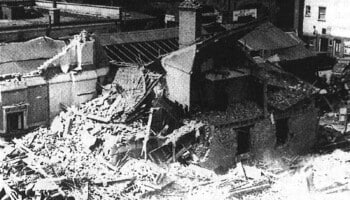
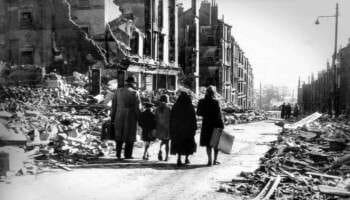
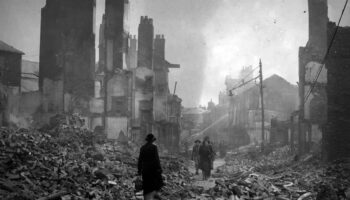
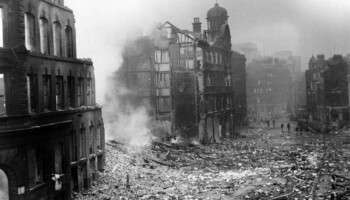
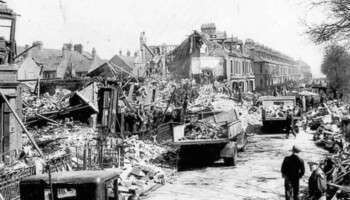
Dover became a symbol for Britain’s wartime bravery and found itself at the centre of East Kent’s ‘Hellfire Corner.’ 1940 saw the worst of the bombing, with significant incidents on Matthews Place, Noah’s Ark Road, Peter Street, Edred Road, St. James Street, Harold Street, Clarendon Street, Manor Road, Connaught Park and Norman Street.
Bomb damage led to widespread evacuation, the population of the town dwindled from more than 40,000 in early 1939 – to an estimated 16,500 in 19401. Somewhat countering the outflow, hundreds of military personnel were billeted in the town to operate the cross-channel guns and extensive anti-aircraft defences.
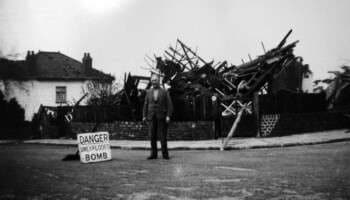
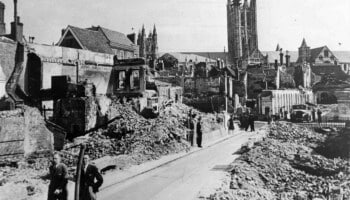
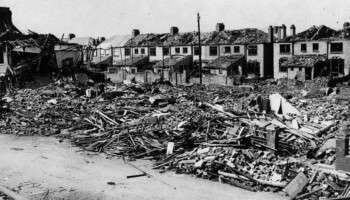
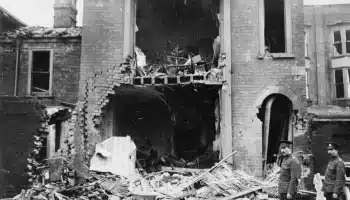
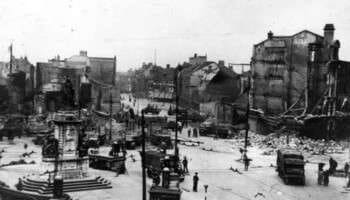
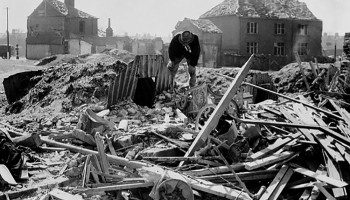
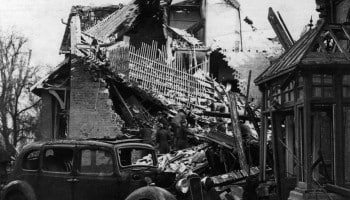
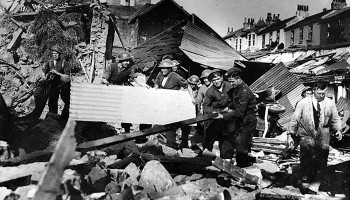
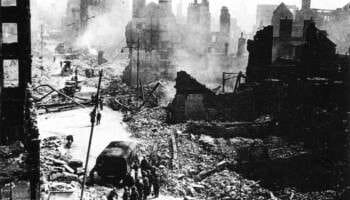
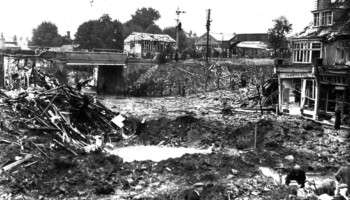
Bomb damage during WWII in Dover. Image credit: Kent Online
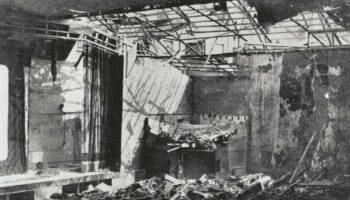
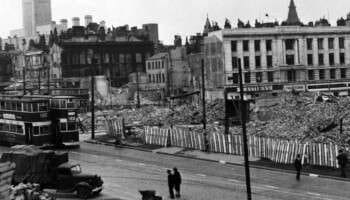
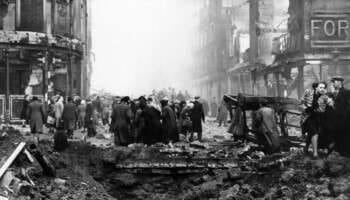
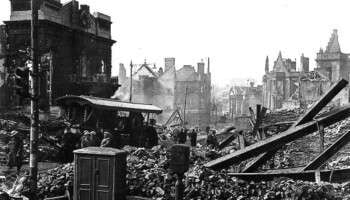
Image showing the remains of the Regal Cinema in Dover following a bombing raid in September 1940. Image credit: Kent Online
The WWII Shelling of Dover
Following Germany’s victory over France in June of 1940, Hitler ordered his military engineers to erect a network of batteries for some of the Third Reich’s biggest guns along the French coast at Cap Gris-Nez. The German military hoped the weapons would close the sea-lane of the English Channel to Allied shipping, but Hitler also planned that his gun emplacements would provide fire support for a future cross-channel invasion of the UK.
Soon, the area around Calais was covered with guns. Nearly twenty pieces were added to six batteries running from Boulogne-Sur-Mer eastwards towards Calais and beyond. The guns ranged in size from comparatively “light” eight-inch cannons capable of ranges up to 33km, to massive 16-inch radar-controlled weapons, which could fire one-ton projectiles more than 50km. At the height of the bombardment, nearly 75 high-calibre weapons were trained onto England’s southern coast.
For the next four years, the German military subjected the Dover Strait and the Kent countryside to a battering of artillery. Shell fragments were found as far as Chatham, Kent, about 88km (55 miles) from the French coast. At least 1,000 attacks were recorded in just over four years.
Dover, which is easily observed from the French shoreline, bore the worst of it. Between August 1940 and September 1944 2,226 shells landed on the town and 686 in the surrounding areas. Hundreds more burst in the air or landed in the harbour2. Up to 10,000 buildings in and around the city were damaged by shellfire and more than 200 civilians were killed with hundreds more injured3.
The final shell fell on Dover in September 1944, after which the guns at Calais were captured by advancing Allied forces.
A 38cm calibre gun of the Todt Battery, located in Haringzelles, Audinghen, near Cape Gris-Nez, Pas de Calais, France. Image credit: Bundesarchiv Bild
“Pooh”, a 14 inch gun at St Margaret’s near Dover, March 1941, with a range of 27 miles. The gun was taken from the stock of guns of the battleship HMS King George V. Image credit: from the collections of the Imperial War Museums
Can UXO still pose a risk to construction projects in Dover?
Yes – UXO can still present a potential risk to construction and development projects in Dover.
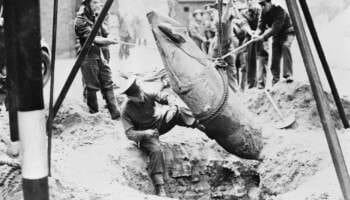
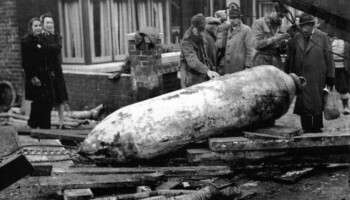
The primary threat comes from German air-delivered bombs dropped during WWII that failed to detonate as intended. It is estimated that around 10% of munitions deployed across the UK did not function correctly. Although significant wartime and post-war bomb disposal operations were carried out, not all unexploded bombs (UXBs) were located or removed.
Ongoing discoveries of UXO during intrusive groundworks across the UK continue to demonstrate that buried wartime ordnance remains a potential risk – including in areas such as Dover.
I am about to start a project in Dover, what should I do?
Before any intrusive groundworks begin, developers, principal contractors, and ground investigation teams should assess potential UXO risk through either:
This forms the first stage of an effective UXO risk mitigation strategy and should be undertaken as early as possible in the project lifecycle, in line with CIRIA C681 guidance.
Why does an early UXO Risk Assessment matter?
Where a credible risk is identified, appropriate mitigation measures should be implemented to reduce risk to As Low As Reasonably Practicable (ALARP).
Equally, unnecessary mitigation can create avoidable project costs, delays and operational disruption.
A professional UXO Risk Assessment will make sure:
- Site-specific threats are properly identified.
- Appropriate mitigation strategies are recommended.
- Unnecessary mitigation measures are avoided.
- Projects remain compliant, safe and commercially efficient.
Early-stage UXO Risk Assessments help developers make informed decisions, protect personnel, maintain compliance and avoid unnecessary expenditure.
If you are planning development or intrusive groundworks in Dover, obtaining a professional and unbiased UXO Risk Assessment should be your first step.
Recent UXO discoveries in Dover
Since the war, many items of UXO have been discovered across multiple cities within the UK, with Dover no exception. See the news articles below about UXO incidents and discoveries from national and local press in Dover.
1st Line Defence keep up-to-date with relevant and noteworthy UXO-related news stories reported across the UK, and you can browse through these articles using the buttons below.
Get UXO risk mitigation services from a partner you can trust
UXO Risk Assessments
Site-specific UXO Risk Assessments using specialist historical research to identify potential threats and determine whether further mitigation is required.
UXO Surveys
Detect and investigate potential buried UXO with specialist Non-intrusive and Intrusive Surveys tailored to your site and proposed groundworks.

UXO Support
On-site UXO support to manage potential ordnance risks during groundworks, protecting personnel and helping your project proceed safely and efficiently.
Free Awareness CPD Seminars
Helping construction professionals understand UXO risk, its potential impact on projects and how it can be effectively managed.
UXO Disposal
Safely manage UXO discoveries with specialist EOD support, from investigation and identification through to clearance and disposal.
International UXO Services
Specialist EOD teams supporting international UXO survey, clearance and disposal projects, with personnel available for rapid deployment worldwide.

Marine UXO Services
Manage UXO risk on marine and offshore projects with specialist survey, investigation, clearance and disposal services tailored to your project.
UXO City Guides

Got a project in Dover? Need advice but not sure where to start?
If you need general advice about UXO risk mitigation in Dover, contact us and we will be happy to help.












Contact Us
* indicates required fields