Home » Resources » UXO City Guides »
UXO City Guide
Home Office Bombing Statistics for Canterbury
Record of German Ordnance dropped on the County Borough of Canterbury
High Explosive Bombs (All types)
455
Parachute Mines
0
Oil Bombs
18
Phosphorus Bombs
10
Fire Pots
48
Pilotless Aircraft (V-1)
1
Long-range Rocket Bombs (V-2)
0
Weapons Total
512
Area Acreage
4,690
Number of items per 1,000 acres
109.2
Why was Canterbury targeted and bombed in WWII?
In several cases, Canterbury was a target of opportunity for German bombers flying to other cities like London; bombers unable to hit their primary target would often drop their ordnance on their return journey, and Canterbury’s location in the south-east of England meant it was in close proximity to the routes that bombers would take on raids to London. Later in the war, Canterbury was one of many places to suffer ‘tip and run’ raids where, due to declining resources, small groups of German planes aimed to cause disruption rather than wide-scale destruction.
However, Canterbury was one of the main targets in the ‘Baedeker Blitz’ of 1942. Aiming to strike a blow at morale by attacking cities with historical and cultural significance, and with its close proximity to German-occupied Europe, the city was selected for a ‘Baedeker’ raid1.
Luftwaffe target photography of Canterbury, highlighting the barracks, military motor garages and warehouses. Image credit: Imperial War Museum
Home Office Bombing Statistics for Canterbury
Canterbury was not subject to a high number of large bombing raids, nevertheless the County Borough sustained a high bombing density according to official Home Office bombing statistics, with an average of 109.2 items of ordnance recorded per 1,000 acres, mainly due to the sheer weight of the ‘Baedeker’ attacks. Combining the ‘Baedeker Blitz’ and other raids, almost 450 recorded high explosive (HE) bombs and thousands of incendiaries fell on Canterbury.
While Canterbury’s largest raids occurred in 1942, bombing was recorded as early as August 1940. These earlier incidents were relatively infrequent in nature, until the ‘Baedeker’ raids where the city was actively targeted by large formations. Attacks on the city continued late into the war, with a V-1 flying bomb landing near the city in 1944.
Major bombing raids in Canterbury
The ‘Baedeker’ Raids
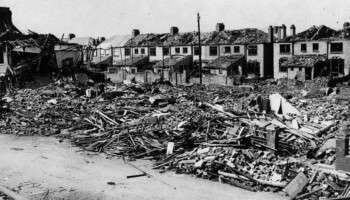
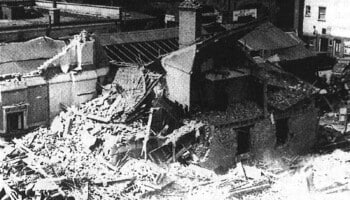
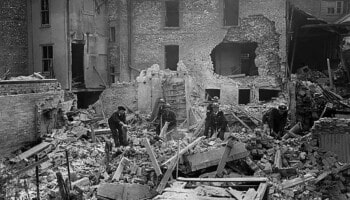
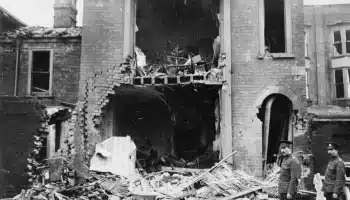
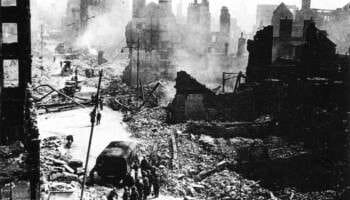
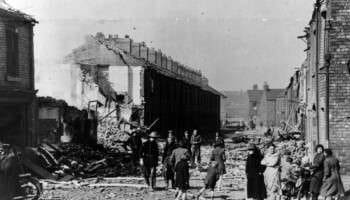
In retaliation for increasing large bombing raids over Germany, Canterbury was attacked in three raids in early June 1942, involving over 175 aircraft in total. Canterbury’s narrow streets and highly flammable historic buildings meant that fires were widespread and damage was substantial. In the first of these raids, several hundred incendiaries were found in the Cathedral precinct alone, with more than 4,000 landing on the city as a whole.
Historic and culturally important buildings with no military significance in Canterbury were targeted by bombing, in order to demoralise the population, though by good fortune, the Cathedral avoided serious damage. Targets of strategic significance were identified in the city however, as the Luftwaffe reconnaissance photograph above illustrates.
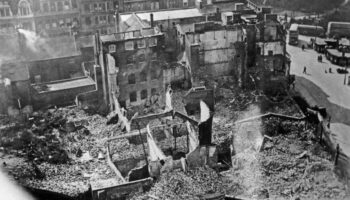
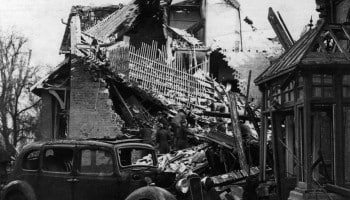
Bomb damage following the ‘Baedeker’ raid near Canterbury Cathedral, 1942. Image credit: Kent Online
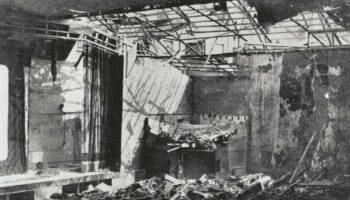
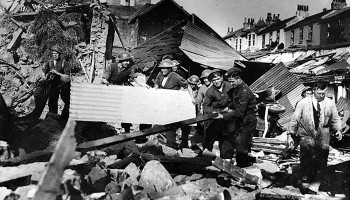
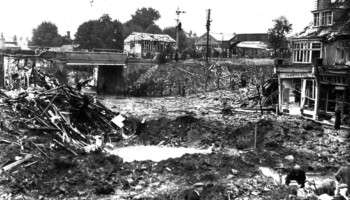
Damage to Burgate, Canterbury, following the Baedeker raids, 1942. Image credit: Internal resource
Major Incidents in Canterbury
- 21st August 1940 – bombing raid demolishes a row of cottages, seven houses, and damages several others.
- ‘Baedeker Raids’ – three separate raids in early June 1942.
- 1st June 1942 – 130 HE bombs and almost 4,000 incendiaries dropped on the city, killing around 115.
- 6/7th June 1942 – 20+ HE bombs were dropped.
- 31st October 1942 – Large ‘tip and run’ raid involving 62 FW 190 fighter-bombers. At least 30 HE bombs were dropped, resulting in 33 deaths and 55 serious injuries.
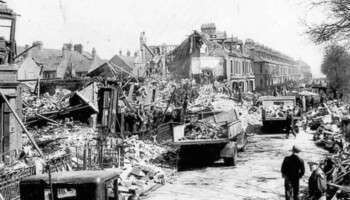
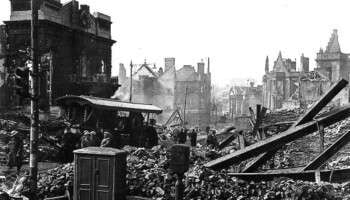
Widespread destruction in Canterbury following the Baedeker raids, 1942. Image credit: Kent Online
‘Tip and Run’ Raids
Later in the war, Germany changed tactics, employing rapid single-engine fighter-bombers to stage lightning strategic and tactical bombing attacks. One of the largest such raids of the war targeted Canterbury, with the speed of the attackers making a response difficult. More than 60 Focke Wulf FW 190 fighter-bombers dropped at least 30 bombs, killing 33 and seriously injuring 55 others.
FW 190 fighter-bomber armed with a heavy 500kg bomb and two 250kg bombs. Dozens of these aircraft attacked Canterbury on 31st October 1942. Image credit: Reddit
A map of bombing incidents across Canterbury. Image credit: The Museum of Canterbury
Can UXO still pose a risk to construction projects in Canterbury?
Yes – UXO can still present a potential risk to construction and development projects in Canterbury.
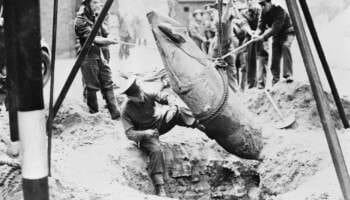
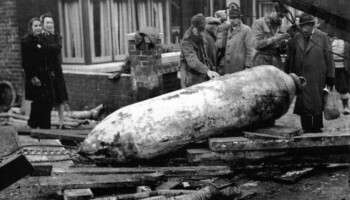
The primary threat comes from German air-delivered bombs dropped during WWII that failed to detonate as intended. It is estimated that around 10% of munitions deployed across the UK did not function correctly. Although significant wartime and post-war bomb disposal operations were carried out, not all unexploded bombs (UXBs) were located or removed.
Ongoing discoveries of UXO during intrusive groundworks across the UK continue to demonstrate that buried wartime ordnance remains a potential risk – including in areas such as Canterbury.
I am about to start a project in Canterbury, what should I do?
Before any intrusive groundworks begin, developers, principal contractors, and ground investigation teams should assess potential UXO risk through either:
This forms the first stage of an effective UXO risk mitigation strategy and should be undertaken as early as possible in the project lifecycle, in line with CIRIA C681 guidance.
Why does an early UXO Risk Assessment matter?
Where a credible risk is identified, appropriate mitigation measures should be implemented to reduce risk to As Low As Reasonably Practicable (ALARP).
Equally, unnecessary mitigation can create avoidable project costs, delays and operational disruption.
A professional UXO Risk Assessment will make sure:
- Site-specific threats are properly identified.
- Appropriate mitigation strategies are recommended.
- Unnecessary mitigation measures are avoided.
- Projects remain compliant, safe and commercially efficient.
Early-stage UXO Risk Assessments help developers make informed decisions, protect personnel, maintain compliance and avoid unnecessary expenditure.
If you are planning development or intrusive groundworks in Canterbury, obtaining a professional and unbiased UXO Risk Assessment should be your first step.
Recent UXO discoveries in Canterbury
Since the war, many items of UXO have been discovered across multiple cities within the UK, with Canterbury no exception. See the news articles below about UXO incidents and discoveries from national and local press in Canterbury.
1st Line Defence keep up-to-date with relevant and noteworthy UXO-related news stories reported across the UK, and you can browse through these articles using the buttons below.
Get UXO risk mitigation services from a partner you can trust
UXO Risk Assessments
Desktop-based risk assessment and historical studies of project site locations to determine whether further investigation is required.
UXO Surveys
Survey your project site location to detect for items of UXO/UXB, suitable for both shallow and deep intrusive ground works – on Land or Marine projects.

UXO Support
Investigate and remove risk during groundworks with a UXO Specialist available 24/7 to support your project and your staff.
Free Awareness CPD Seminars
If a UXO risk has been identified on your project, we recommend that Awareness Training is undertaken to make sure personnel are aware about the risks.
UXO Disposal
Discover about the different types of UXO Disposal services we provide and how we mitigate risk on your project.

International UXO Services
We can rapidly deploy Explosive Ordnance Disposal (EOD) Engineers for International UXO Clearance and Disposal projects.

Marine UXO Services
Mitigate the risk of UXO on your marine or offshore project with our industry-leading detection and disposal services.
UXO City Guides










Got a project in Canterbury? Need advice but not sure where to start?
If you need general advice about UXO risk mitigation in Canterbury, contact us and we will be happy to help.












Contact Us
* indicates required fields